ivygo
Helping Hosts Earn from EV Charging, with Less Risk and More Trust
9 min read
- Role
- UX/UI Specialist & Product Strategy Lead
- Tools
- Miro, Askable, Gemini AI, Google Docs, Zoom
- Users
- Small business hosts (wineries, regional cafes, boutique B&Bs) and regional EV drivers
- Timeline
- 12 weeks
Overview
I led research and product strategy for an EV charging marketplace, drawing on interviews with 11 hosts and drivers to find out what holds small hospitality hosts back from charging for EV power. I turned the findings into three feature pillars and a phased 12-month roadmap for the founder and CEO.
ivygo connects EV drivers with charging stations hosted by small hospitality businesses such as wineries, regional cafes and boutique B&Bs. Bookings and payments work smoothly.
The interviews showed hosts weren't held back by the technology. They were held back by technical anxiety, admin dread, and fear of looking greedy to guests, a pattern I named the “Passive Plateau.”
Impact
- 11 in-depth host and driver interviews
- 12 weeks from brief to strategy handoff
- 3 feature pillars across a phased roadmap
Challenge
Australians are adopting EVs fast, and road-trippers actively seek out wineries, cafes, and boutique stays where they can charge. Hosts see this as a marketing opportunity, but running a charger feels like an unpredictable technical chore.
Most default to giving power away free rather than deal with the admin and risk. That's a missed revenue stream hiding in plain sight. ivygo needed to know exactly what would move hosts from avoidance to confident monetisation.
How might we make charging guests for EV power feel as simple and safe for hosts as giving it away for free?
Objective
- Understand why hosts offer charging, and what stops them charging for it.
- Define the host types and the barriers each one faces.
- Turn the findings into a phased roadmap ivygo can build from.
Researching the problem space
Background from the client
ivygo shared its own material at the start: a guide for hospitality venues, a briefing pack for its business development team, and the plan for its first regional rollout. Together they set out the business and the assumptions my research would test.
- The model: a community-powered network that makes under-used business and home chargers bookable, with hospitality venues as the core focus. Hosts list for free, with no subscription or lock-in, and ivygo takes a percentage fee on bookings, so it only earns when hosts do.
- Two ways in: venues that already have a charger can go live straight away; venues without one get a supported installation, with optional finance.
- The first region: the Hunter Valley, chosen for its cluster of wineries, restaurants and stays within two hours of Sydney, where visitors linger for hours or overnight and fewer than 1 in 20 venues offered usable charging.
- The client's hypotheses: that venues often give charging away free without marketing support, and that hosts hold back because the setup feels complex and the return unclear.
The interviews tested those assumptions from the host's side of the counter.
This was a research- and strategy-led engagement: working out what the product needed to do and in what order, not producing high-fidelity UI. I ran a three-stage process:
- Discover: remote interviews with small business hosts and regional EV drivers, fitting around limited availability
- Synthesise: pooled findings with a wider research cohort in Miro, clustering pain points to separate individual noise from shared market patterns
- Product Strategy: mapped the emotional journey hosts go through and translated sticking points into concrete features, security controls, and a release schedule for engineering
Recruitment shifted to Askable and my professional network after research launched during a major holiday travel rush, protecting data quality without adding to hosts' already stretched schedules.
Desk research: learning how EV charging works
Before interviewing hosts and drivers, I needed to understand what charging an EV actually involves. This is a full charging session at a public fast charger, from finding the charger in its app to watching the battery fill.
The session, step by step: finding the charger and choosing a plug in the Evie app, which shows each plug's speed, price per kWh and availability; checking the variable pricing; scanning the charger's QR code; plugging in; following the charge in the app; and reading the charger's own screen as the battery reaches 96%.
Synthesis summary
Key themes by research objective
Why hosts offer charging
- Attract guests and stand out from nearby venues
- Back up a sustainability promise
- Give EV drivers peace of mind on longer trips
What stops them charging for it
- Fear of looking greedy to guests
- Low usage and an unclear return
- Little confidence with EVs
How they want to price it
- Split between flat fees and per-kWh pricing
- Protection from electricity price spikes
- Free slow charging, paid fast charging
How it fits their workday
- No appetite for extra admin or spreadsheets
- Automated, with a manual override
- Guarding against misuse and blocked bays
Where ivygo can help
- Getting chargers seen on maps and listings
- A host login and direct messaging
- Clear earnings and payback
What I found
The founder interview pointed to five priorities: real-time charger status and two-way communication so staff can respond fast; reliability with minimal day-to-day management; reduced risk around theft, misuse and unexpected costs; charging as a draw for guests and a boost to the sustainability offering; and simple, transparent pricing paired with accessible, non-technical troubleshooting.
Three consistent host anxieties
Fear of appearing greedy
Hosts worried monetising charging would clash with the hands-off, “luxurious” experience they wanted guests to have
No appetite for admin
Hosts wanted charging to run itself, with no extra spreadsheets or tracking
Real financial risk aversion
Hosts couldn't absorb an unexpected high electricity bill
“It's a slippery slope. Destination chargers at accommodation sites are generally free. I worry monetisation could appear greedy.”
What the research interviews showed
Our research cohort pooled its interviews with nine hosts and two EV drivers, from a city retail store to regional motels, a country guesthouse and a family farm. I synthesised them into eight themes, each linked to a part of the roadmap. Participants were promised anonymity, so quotes are attributed by role only.
Research interviews at a glance
Eight themes from 11 hosts and drivers
- Hosts interviewed
- 9
- EV drivers interviewed
- 2
- Hosts with a charger who already charge for it
- 5 of 8
- Real cost of one session at a single motel
- $3–$35
A draw for guests first, income second
Most hosts installed chargers to attract a certain kind of guest and stand out, not to make money.
“I don't think I'm going to get the big bucks by offering EV charging… It's just a way to attract a particular kind of customer.”
Informs: “EV Friendly” listing badges
Pricing feels awkward and unproven
Hosts worry about looking greedy, and set prices by guesswork. Drivers expect charging to be free at hotels, but will pay at restaurants and wineries.
“It's like WiFi – it used to be an extra charge, now it's just expected.”
Informs: Payback Visualiser and transparent pricing
Energy costs are unpredictable
Wholesale price spikes, solar and battery levels all change what a session costs. Hosts want protection, not surprise bills.
“We want to offer it, but we can't incur… a $100 bill that we swallow.”
Informs: Bill Shield and solar, battery and grid metrics
Automated, with a manual override
At low volumes, spreadsheets and bank exports are tolerable. Hosts want the system to run itself, but to step in when something goes wrong.
“Automated day-to-day and manual when needed.”
Informs: Real-Time Command Centre and CSV reports
Chargers are hard to find, and hosts can't reach guests
Guest-only chargers don't appear on charging maps, and some hosts rely on Google Maps alone. One existing ivygo host had no host login: every update arrived by text, with no way to message drivers.
Informs: The web-based host login and direct messaging
Drivers want certainty and fewer apps
Drivers plan around chargers they trust, and resent needing a new app for every network.
“Reliable matters most… If I could book it in advance, that would be amazing. I'd pay extra for that, no question.”
Informs: Booking and real-time availability
Misuse needs guarding against
Guests charged from an outlet in a meter box, staff used a charger for private cars, a driver pulled away still plugged in, and fully charged cars blocked bays.
Informs: The pairing wizard and session authentication
Two very different kinds of host
Some hosts are unsure of EVs and want training first. Others are technical, ROI-focused investors who want per-kWh and dynamic pricing.
Informs: Tiered features, from simple setup to advanced controls
Building user empathy
I distilled these anxieties into three host personas.
The Passive Plateau
Mapping Maya's journey showed host confidence drops sharply after setup and stays low until a shock bill forces action. That low stretch is the Passive Plateau.
Read the user journey as text
One host's guest found and used an unsecured power outlet to charge, unprompted. That was proof the demand already existed and simply wasn't being met.
The Proposed Solution
I proposed a web-based login area for hosts as the best fit, because it integrates with how these businesses already work day to day, rather than adding another app or process for them to manage.
I defined three feature pillars, each answering one of the fears surfaced in research, sequenced into a 12-month, three-phase roadmap.
Phase 1: Build Confidence (0–3 months)
- Real-Time Command Centre: high-contrast earnings tracker, hardware “heartbeat” status, direct messaging, help and support
- Simplified pairing wizard and booking management to remove setup anxiety
Phase 2: Remove Friction (3–6 months)
- Payback Visualiser: hosts enter setup cost and see an automatic 12–24 month break-even timeline, turning an abstract decision into a provable ROI case
- Automated payment splitting and monthly CSV accounting reports
- Energy source usage metrics (solar, battery, grid)
Phase 3: Strategic Growth (6–12 months)
- Invisible Grid Intelligence: Kitchen Failsafe throttles charging if property power load nears capacity; Bill Shield auto-pauses charging if grid costs spike
- Solar-first optimisation and downloadable “EV Friendly” listing badges
Host dashboard concept
The full research report
Step through the report I delivered to ivygo's founder. The note under each slide summarises its key points.
Slide 1 of 25
Unlocking Monetisation, Reducing Risk & Enhancing Trust
The cover: Research Synthesis and Analysis for ivygo, 2026, by Eleonor Collins, UX/UI Specialist.
Project Reflection
Outcome
The unsecured-outlet story landed with real weight. As an EV driver herself, ivygo founder Julie Perrissel had done exactly the same thing when no proper charging was available. That personal recognition gave the roadmap conversation immediate credibility.
Proposing everything at once was a risk with an already tech-hesitant audience, so I handed Julie the phased roadmap for review and implementation. Concept visuals for the Real-Time Command Centre dashboard were produced after handover to support the pitch.
What's next?
The roadmap is with ivygo for review and implementation. If I took it further, I'd:
- Test the Phase 1 host dashboard with real hosts, starting with those who are least confident with EVs.
- Check the Payback Visualiser against real usage and electricity costs, since hosts put their payback anywhere from two to four years.
- Interview more EV drivers. Only two took part, so the driver side of the booking experience needs more evidence before it's built.
Project takeaways
- A real story can do more than a statistic. The Airbnb host's guest who charged from the meter box made the problem instantly relatable: Julie had done the same thing herself. One true story made the case for the roadmap faster than any chart.
- Test the client's assumptions, not just the users'. ivygo expected most hosts to give charging away free. The interviews showed a more mixed picture, with many hosts already charging, which changed how the problem was framed.
Reference
Appendix
Supporting documents from the research: the stakeholder interview questions and the full host personas.
Stakeholder interview questions
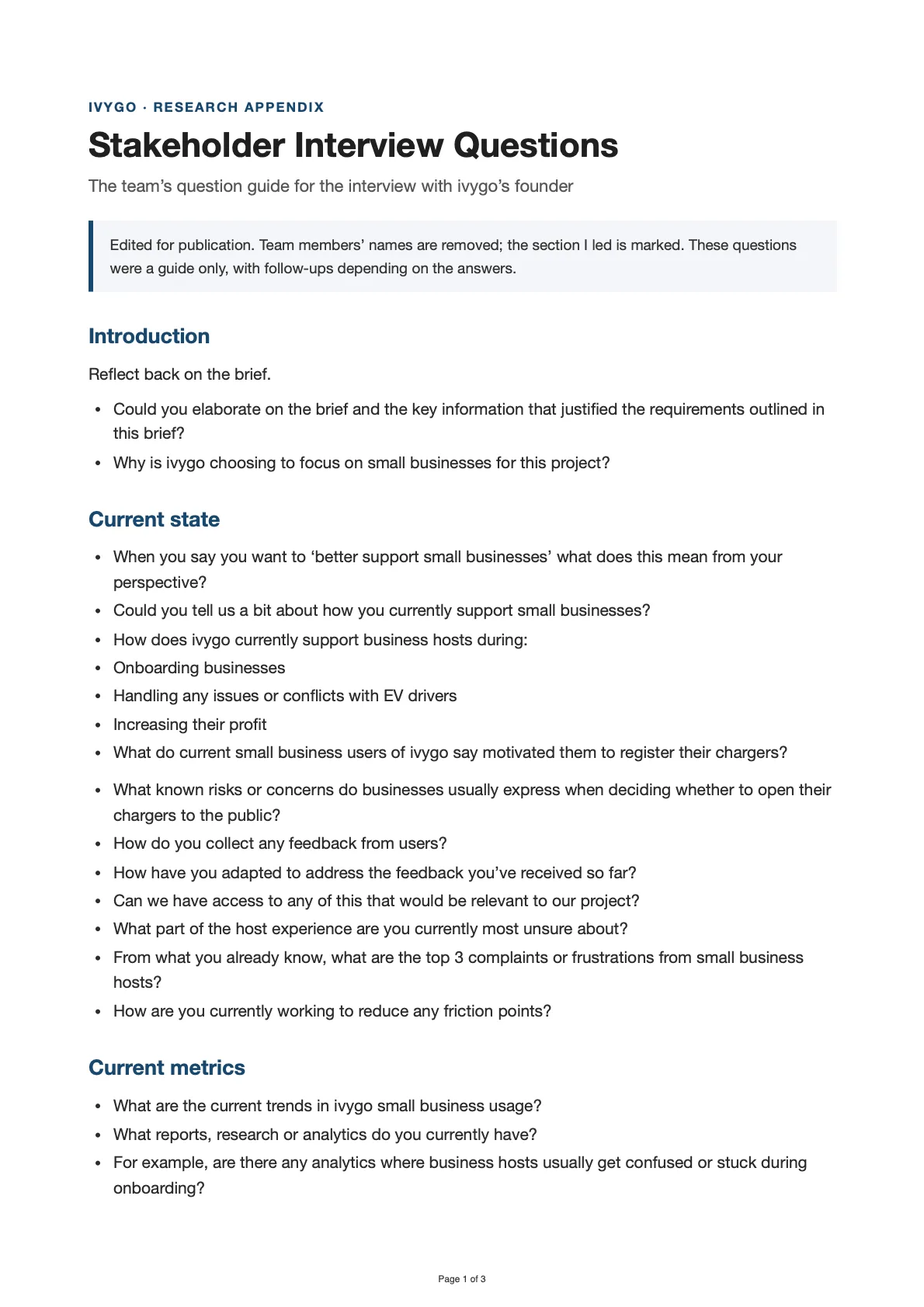
The team's question guide for the interview with ivygo's founder, including the questions on effective monetising that I asked. It has been edited for publication: team members' names are removed.
Page 1 of 3
Introduction, current state and current metrics
Title page, then questions reflecting on the brief, how ivygo supports small business hosts today, and what usage data exists.
Read the text version
Host personas
The three host personas from my research report, in full. Each is a composite built from the hosts we interviewed.
Persona 1: The Forward-Thinker Host
Read Liam's persona as text
Persona 2: The Busy Host
Read Maya's persona as text
Persona 3: The Reluctant Host
Read Avery's persona as text
Have a project in mind?
Let's discuss how my design system, accessibility and product strategy skills can help your team.